
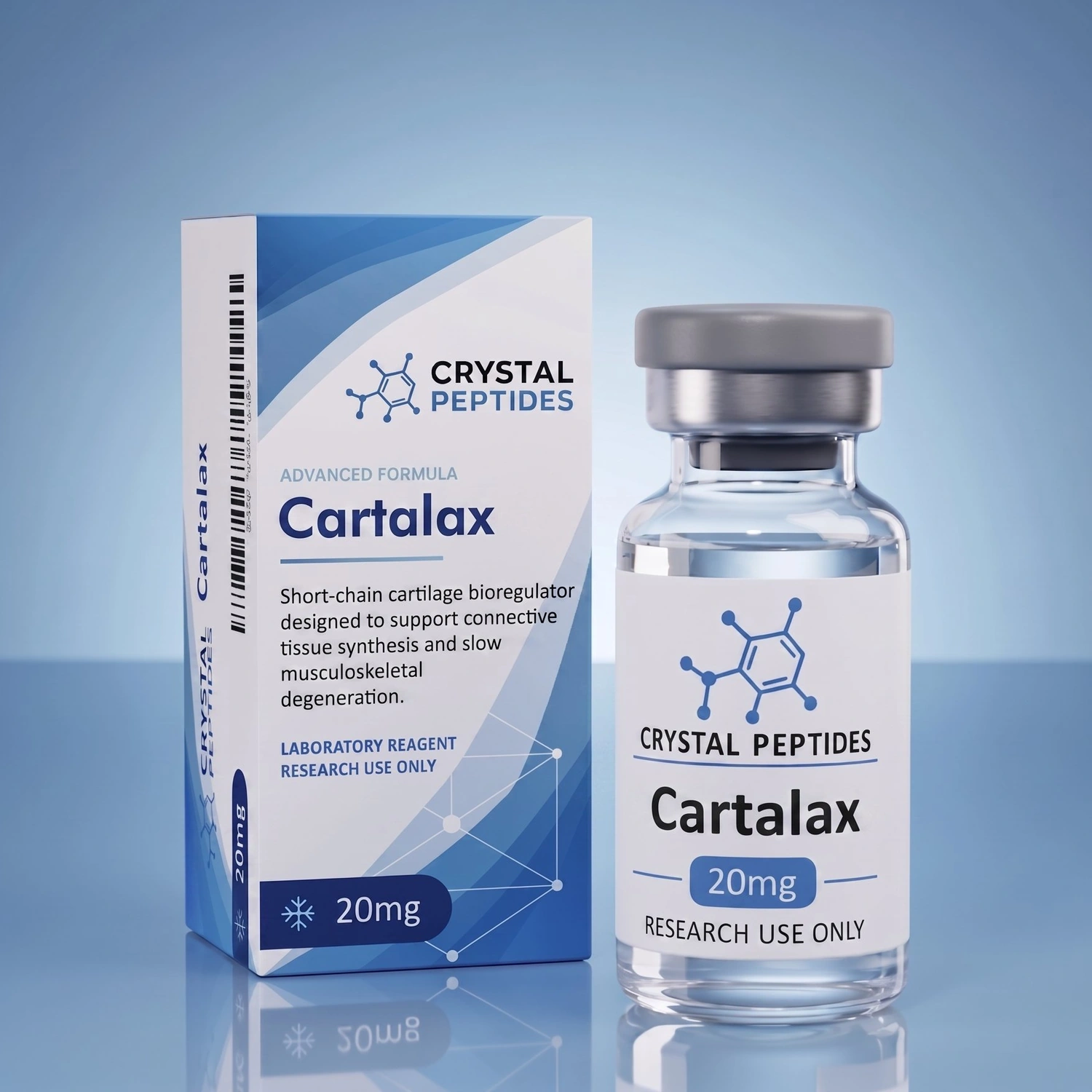
Cartalax (20mg)
20mg
❄️Liofiliziran prašek (nerekonstituiran)
Skupaj: €49.99
Popust na količino
| Količina | Popust | Cena na enoto |
|---|---|---|
| 5 - 10 | 10% | €44.99 |
| 11 - 20 | 15% | €42.49 |
| 21+ | 20% | €39.99 |
Strogo testiranje tretjih oseb
Vsaka serija naših raziskovalnih kemikalij in peptidov je podvržena neodvisnemu laboratorijskemu testiranju tretje osebe glede čistosti in identitete.
Skupaj: €49.99
Kaj je Cartalax?
Cartalax je kratek sintetični tripeptid, sestavljen iz alanina, glutaminske kisline in asparaginske kisline (Ala-Glu-Asp), znan tudi kot peptid AED. V znanstveni literaturi in kemijskih zbirkah podatkov je identificiran tudi pod svojim razvojnim imenom, peptid T-31. Raziskave peptida Cartalax/AED so proučevale celično staranje, spremembe genskega izražanja in biološke procese, relevantne za raziskave vezivnega tkiva in hrustanca, čeprav razpoložljivi dokazi ostajajo omejeni in pretežno predklinični.
Raziskovalci, ki želijo kupiti Cartalax v Evropi, lahko peptid pridobijo pri podjetju Crystal Peptides, dobavitelju visoko čistih raziskovalnih spojin, ki se osredotoča na neodvisno preverjanje kakovosti. Vsaka nova serija izdelka je testirana s strani neodvisnih analitskih laboratorijev, kot je Janoshik, glede ustreznih parametrov kakovosti, vključno z identiteto, čistostjo in sterilnostjo. Za vsako serijo je priložen certifikat o analizi, specifičen za posamezno serijo, ki dokumentira sporočene rezultate.
Ta izdelek se prodaja izključno za raziskovalno uporabo in ni namenjen uporabi pri ljudeh ali živalih.
Kaj je vključeno
Cartalax je dobavljen kot liofiliziran prah v zatesnjeni stekleni viali. Material je običajno bele do skoraj bele barve.
Certifikat o analizi (CoA) je na voljo za vsako serijo izdelka po testiranju s strani neodvisnih zunanjih laboratorijev. Glede na laboratorij in testirani izdelek lahko CoA vključuje analitske rezultate, kot so:
• Testiranje identitete: Potrjuje, da material ustreza Cartalaxu (Ala-Glu-Asp).
• Čistost HPLC: Meri delež glavne komponente Cartalaxa glede na zaznavne kromatografske nečistoče.
• Masna spektrometrija (MS): Zagotavlja podatke o molekulski masi v podporo identiteti in karakterizaciji peptida.
• Vsebnost peptida: Pomaga določiti količino Cartalaxa, prisotno v testiranem materialu.
• Sorodne peptidne nečistoče: Kjer je poročano, identificira ali količinsko opredeli skrajšane zaporedja, nečistoče, povezane s sintezo, ali druge različice peptida.
• Testiranje endotoksinov: Kjer je izvedeno, ocenjuje ravni bakterijskih endotoksinov, kar je lahko pomembno za laboratorijske eksperimente z občutljivimi biološkimi sistemi.
• Testiranje sterilnosti: Kjer je primerno, ocenjuje material glede zaznavne mikrobne kontaminacije.
• Preostala topila ali druge nečistoče, povezane s procesom: Kjer je primerno, pomaga oceniti onesnaževala, ki izvirajo iz sinteze ali čiščenja peptida.
CoA, specifičen za posamezno serijo, je treba uporabiti kot dokončni vir za analitske rezultate in specifikacije dobavljene serije Cartalaxa. Parametri testiranja se lahko razlikujejo glede na izdelek in neodvisni laboratorij, ki izvaja analizo.
Prosimo, upoštevajte, da raztopina za rekonstitucijo ni vključena v vaše naročilo Cartalaxa. Če jo potrebujete za svoje laboratorijsko delo, lahko svojemu naročilu dodate BAC Water (10 ml).
Tehnične specifikacije
Lastnost | Specifikacija |
Ime izdelka | Cartalax |
Alternativna imena | AED, Ala-Glu-Asp, peptid T-31 |
Vrsta molekule | Sintetični tripeptid |
Aminokislinsko zaporedje | Ala-Glu-Asp (AED) |
Dolžina peptida | 3 aminokisline |
Molekulska formula | C₁₂H₁₉N₃O₈ |
Molekulska masa | 333,29 g/mol |
PubChem CID | 87815447 |
Videz | Liofiliziran prah |
Čistost | Za informacije, specifične za serijo, preverite CoA |
CAS številka | 85806-95-7 |
Predvidena uporaba | Samo za laboratorijske raziskave. Ni namenjeno uporabi pri ljudeh ali živalih. |
Opomba: Pri ocenjevanju raziskovalnega materiala Cartalax je treba uporabiti analitsko dokumentacijo, specifično za serijo, za potrditev natančne identitete, čistosti in specifikacije dobavljenega materiala.
Pregled Cartalaxa in mehanizem delovanja
Cartalax je kratek sintetični tripeptid, sestavljen iz alanina, glutaminske kisline in asparaginske kisline, običajno zapisan kot Ala-Glu-Asp ali AED. V delu znanstvene literature je poimenovan tudi T-31. Raziskave Cartalaxa so se pretežno osredotočale na njegov morebitni vpliv na celične in molekularne procese, namesto na en sam, dobro opredeljen receptorski ali encimski cilj.
Eksperimentalne študije z AED so preučevale spremembe v genskem izražanju in celični aktivnosti v več laboratorijskih modelih, vključno s človeškimi mezenhimskimi matičnimi celicami, fibroblasti in kulturami ledvičnih celic. Te ugotovitve so prispevale k raziskavam o tem, kako kratki regulatorni peptidi lahko vplivajo na celične procese, čeprav mehanizmi, ki so podlaga za aktivnost Cartalaxa, ostajajo nepopolno opredeljeni, razpoložljivi dokazi pa so pretežno predklinični.
AED in raziskave peptidnih bioregulatorjev
Predlagani model bioregulatorja nakazuje, da lahko zelo kratki peptidi vplivajo na celične regulatorne procese in gensko izražanje. V tem okviru je bil Cartalax/AED posebej povezan z raziskavami biologije vezivnega tkiva in hrustanca.
Vendar je treba dokaze razlagati glede na uporabljeni eksperimentalni model. Objavljene raziskave ne dokazujejo enega samega, neodvisno potrjenega receptorja ali molekularne poti, prek katere naj bi Cartalax povzročal vse svoje sporočene učinke.
Raziskave genskega izražanja
AED je bil preučevan glede njegove sposobnosti vplivanja na vzorce genskega izražanja v starajočih se celičnih kulturah. Raziskave na človeških mezenhimskih matičnih celicah so preučevale spremembe v genih, povezanih z vzdrževanjem in diferenciacijo celic, medtem ko so druge študije preučevale kratke peptide, vključno z AED, v starajočih se kulturah ledvičnih celic. [1]
Te ugotovitve zagotavljajo osnovo za nadaljnje laboratorijsko raziskovanje AED kot regulatornega peptida, vendar opažanj v celičnih kulturah ni mogoče razlagati kot dokaz o uveljavljenem biološkem učinku pri ljudeh.
Predlagana interakcija s celičnim regulatornim mehanizmom
Nekatere raziskave nakazujejo, da lahko kratki peptidi, kot je AED, medsebojno delujejo s kromatinom ali DNK in s tem vplivajo na transkripcijo. Za preučevanje te hipoteze so bili uporabljeni molekularno modeliranje in povezane eksperimentalne študije. Vendar dokazi o za Cartalax specifičnem mehanizmu vezave na DNK ostajajo omejeni. Ta mehanizem je zato treba obravnavati kot predlagan model za nadaljnje raziskave in ne kot uveljavljen način delovanja. [2]
Raziskave, povezane s Cartalaxom in hrustancem
Cartalax je v komercialnem kontekstu pogosto opisan kot peptid, povezan s hrustancem, zaporedje AED pa je bilo preučevano v eksperimentalnih modelih, relevantnih za vezivno tkivo in biologijo mezenhimskih matičnih celic. Vendar neposredni dokazi, ki bi posebej povezovali izolirani tripeptid AED z učinki na hrustanec, ostajajo omejeni. [2]
Za raziskovalne namene je Cartalax zato najbolje obravnavati kot spojino, zanimivo za preučevanje regulacije kratkih peptidov, genskega izražanja in celične biologije, povezane s hrustancem, in ne kot spojino z uveljavljenim mehanizmom, specifičnim za hrustanec.
Raziskovalne aplikacije in znanstveno ozadje
Cartalax, znan tudi kot Ala-Glu-Asp (AED) ali T-31, je bil preučevan predvsem na področju raziskav kratkih peptidnih bioregulatorjev. Objavljena literatura je razmeroma omejena, raziskave pa se osredotočajo predvsem na modele celičnih kultur in predlagane učinke na gensko izražanje in celično regulacijo.
Raziskave mezenhimskih matičnih celic
AED je bil preučevan v kulturah človeških mezenhimskih matičnih celic, vključno z modeli, zasnovanimi za preučevanje celičnih sprememb, povezanih z replikativnim staranjem. Raziskave na tem področju so preučevale, ali lahko kratki peptidi spremenijo izražanje genov in beljakovin, povezanih z vzdrževanjem in diferenciacijo celic. [4]
Te ugotovitve zagotavljajo osnovo za nadaljnje laboratorijsko raziskovanje AED, vendar rezultatov celičnih kultur ni mogoče razlagati kot dokaz o uveljavljenem učinku pri ljudeh.
Raziskave hrustanca in hondrocitov
Cartalax je pogosto povezan z raziskavami hrustanca, saj je bil peptid AED preučevan v eksperimentalnih modelih, povezanih z biologijo hondrocitov. Študija iz leta 2023 je poročala o spremembah v izražanju markerjev, vključno s SOX9, agrekanom, kolagenom tipa II in COMP, v starajočih se kulturah človeških mezenhimskih matičnih celic, izpostavljenih AED. [4]
Razpoložljivi dokazi pa ostajajo omejeni. Pogosto uporabljen opis Cartalaxa kot za hrustanec specifičnega ali hondroprotektivnega peptida presega tisto, kar je trenutno mogoče ugotoviti na podlagi široke, neodvisno ponovljene dokazne osnove.
Raziskave genskega izražanja
Eno od ponavljajočih se področij zanimanja v raziskavah AED je regulacija genskega izražanja. Študije iz raziskovalnega programa Khavinson so preučevale, ali lahko kratki peptidi vplivajo na transkripcijske vzorce v gojenih celicah, vključno z modeli celičnega staranja. [4]
Te raziskave zagotavljajo okvir za preučevanje AED kot potencialnega celičnega regulatornega peptida, čeprav natančni molekularni mehanizmi ostajajo področje za nadaljnje proučevanje.
Raziskave fibroblastov in vezivnega tkiva
Kratki peptidi iz raziskovalnega programa Khavinson, vključno z AED, so bili preučevani tudi v modelih fibroblastov in vezivnega tkiva. Ti eksperimenti so preučevali celične funkcije in spremembe, povezane s staranjem in vzdrževanjem tkiv.
Za laboratorijske raziskovalce to pomeni, da je Cartalax relevanten za raziskave regulacije kratkih peptidov, biologije vezivnega tkiva in celičnega staranja.
Raziskave peptidnih bioregulatorjev
Cartalax je del širše skupine zelo kratkih peptidov, razvitih v okviru raziskovalnega programa bioregulatorjev Khavinson. Predlagani koncept je, da lahko kratka peptidna zaporedja vplivajo na celične regulatorne procese, vključno z vzorci genskega izražanja.
To ostaja raziskovalna hipoteza, ne pa uveljavljen splošni mehanizem. Pri ocenjevanju dokazov za AED je treba upoštevati omejeno število študij, koncentracijo raziskav znotraj ene same znanstvene skupine in pomanjkanje neodvisne ponovitve.
Omejitve raziskav
Znanstvena literatura o Cartalaxu je znatno manjša od tiste, ki je na voljo za številne bolje raziskane raziskovalne peptide. Velik del prepoznavnih raziskav AED izvira iz istega raziskovalnega omrežja, prav tako ni trdnih neodvisnih kliničnih dokazov, ki bi Cartalax uveljavili kot zdravljenje motenj hrustanca, bolezni sklepov ali staranja.
Zaradi tega je Cartalax najbolje obravnavati kot eksperimentalni peptid za laboratorijsko raziskovanje celične in molekularne biologije, povezane z AED, in ne kot spojino z uveljavljenimi terapevtskimi uporabami.
Primerjava Cartalax proti BPC-157 proti GHK-Cu proti Epitalonu
Cartalax, BPC-157, GHK-Cu in Epitalon so vsi predmet raziskav peptidov, vendar se bistveno razlikujejo po molekularni strukturi, sestavi in raziskovalnem kontekstu.
Lastnost | Cartalax (AED) | |||
Vrsta molekule | Sintetični tripeptid | Sintetični peptid | Kompleks baker–tripeptid | Sintetični tetrapeptid |
Zaporedje / sestava | Ala-Glu-Asp (AED) | Peptid s 15 aminokislinami | Gly-His-Lys (GHK), povezan z bakrom | Ala-Glu-Asp-Gly (AEDG) |
Dolžina peptida | 3 aminokisline | 15 aminokislin | 3 aminokisline + baker | 4 aminokisline |
Molekularna razlika | Kratek peptid brez kovinske komponente | Daljši linearni peptid | Kompleks peptid–kovina | Zaporedje AED z dodatnim ostankom glicina |
Primarni raziskovalni kontekst | Raziskave genskega izražanja, celične in vezivnega tkiva | Celične, tkivne in eksperimentalne raziskave popravljanja | Raziskave zunajceličnega matriksa, fibroblastov in od bakra odvisnih celičnih procesov | Raziskave celičnega staranja in kratkih peptidov |
Mehanistični poudarek | Predlagani regulatorni učinki na celične in genske izražene procese | Več predlaganih molekularnih in celičnih poti | Interakcije peptid–baker in nadaljnji celični procesi | Predlagani učinki na celične in genske izražene poti |
Opredeljen receptorski cilj | Ni enotnega uveljavljenega receptorskega cilja | Ni enotnega uveljavljenega receptorskega cilja | Ni enotnega uveljavljenega receptorskega cilja | Ni enotnega uveljavljenega receptorskega cilja |
Ključna raziskovalna ugotovitev | Omejeni in pretežno predklinični dokazi | Široka predklinična raziskovalna osnova | Kemijsko vedenje je odvisno od sestave peptid–baker | Strukturno različen od AED kljub prekrivanju zaporedja |
Raziskovalna opomba
Razlikovanje med Cartalaxom in Epitalonom je še posebej pomembno, ker se njuni zaporedji prekrivata: Cartalax je Ala-Glu-Asp (AED), medtem ko je Epitalon Ala-Glu-Asp-Gly (AEDG). Dodatni glicin naredi Epitalon drugačno molekularno entiteto. Podobno GHK-Cu ni preprosto še en peptid s tremi aminokislinami, saj je njegova povezava z bakrom sestavni del njegove molekularne identitete.
Shranjevanje in laboratorijsko ravnanje
Cartalax je dobavljen kot liofiliziran tripeptid. Ohranjanje materiala zatesnjenega, suhega in zaščitenega pred nepotrebno izpostavljenostjo okolju pomaga ohraniti njegovo analitsko celovitost med laboratorijskim shranjevanjem.
• Vialo hranite zatesnjeno in zaščiteno pred vlago, kadar ni v uporabi.
• Shranjujte v skladu z dokumentacijo izdelka in veljavnimi priporočili, specifičnimi za serijo.
• Zaščitite pred prekomerno vročino in dolgotrajnimi temperaturnimi nihanji.
• Zaščitite pred neposredno ali dolgotrajno izpostavljenostjo svetlobi.
• Ohlajeni ali zamrznjeni viali po potrebi pred odpiranjem omogočite, da doseže ustrezno temperaturo, da zmanjšate kondenzacijo na liofiliziranem materialu.
• Po rekonstituciji upoštevajte pogoje shranjevanja in stabilnosti, določene za specifično pripravo in eksperimentalni protokol.
• Izogibajte se nepotrebnim ponavljajočim se ciklom zamrzovanja in odtajanja pri delu s pripravljenimi raztopinami.
• Uporabljajte ustrezne laboratorijske postopke za zmanjšanje kontaminacije med pripravo in ravnanjem.
Trenutno je na voljo omejeno objavljenih podatkov o stabilnosti, specifičnih za peptid AED (Ala-Glu-Asp). Zato specifičnih rokov uporabnosti za Cartalax ne smemo predpostavljati zgolj na podlagi splošnih praks shranjevanja peptidov. Ko kupujete Cartalax za laboratorijske raziskave, preverite priloženi CoA za specifične smernice glede ravnanja in priprave.
Certifikat o analizi in zagotavljanje kakovosti
Certifikat o analizi (CoA) zagotavlja analitske podatke, specifične za serijo dobavljenega materiala Cartalax. Za opredeljen tripeptid, kot je Cartalax, so najpomembnejši premisleki, ali sporočeni rezultati podpirajo identiteto materiala in ali njegova sporočena čistost izpolnjuje veljavno specifikacijo.
Kako oceniti CoA Cartalaxa
Pri pregledovanju CoA morajo raziskovalci upoštevati:
• Identiteta: Ali analitski podatki potrjujejo predvideni peptid Ala-Glu-Asp (AED)?
• Čistost: Ali sporočena čistost izpolnjuje navedeno specifikacijo izdelka?
• Analitske metode: Ali so uporabljene metode primerne za preverjanje identitete in čistosti peptida?
• Podatki o seriji: Ali CoA jasno ustreza specifični seriji, ki se kupuje ali proučuje?
• Dodatni parametri kakovosti: Ali rezultati, kjer je poročano, zagotavljajo pomembne informacije o onesnaževalih ali drugih lastnostih kakovosti?
Parametri testiranja in specifikacije se lahko razlikujejo med izdelki in neodvisnimi laboratoriji.
Ko kupujete Cartalax pri podjetju Crystal Peptides, preverite, ali se številka serije/SKU ujema s tisto na najnovejšem CoA. CoA za specifično serijo Cartalaxa je treba obravnavati kot dokončni vir za analitske lastnosti dobavljenega materiala.
Pogosto zastavljena vprašanja
Kaj je Cartalax?
Cartalax je kratek sintetični tripeptid, sestavljen iz alanina, glutaminske kisline in asparaginske kisline. Njegovo zaporedje je zapisano kot Ala-Glu-Asp ali AED, v kemijskih in znanstvenih zbirkah podatkov pa je identificiran tudi kot peptid T-31.
Kakšno je peptidno zaporedje Cartalaxa?
Peptidno zaporedje Cartalaxa je Ala-Glu-Asp (AED). Vsebuje tri aminokislinske ostanke in ima molekulsko maso približno 333,29 g/mol. Raziskovalci morajo zaporedje preveriti glede na analitsko dokumentacijo, priloženo določenemu raziskovalnemu materialu.
Ali je Cartalax enak kot AED ali T-31?
Da. Cartalax, Ala-Glu-Asp (AED) in peptid T-31 so imena, ki se uporabljajo za isti peptid s tremi aminokislinami v kemijskih zbirkah podatkov in znanstveni literaturi. PubChem navaja Cartalax, Ala-Glu-Asp in peptid T-31 med sopomenkami spojine AED.
Ali je Cartalax enak kot Epitalon?
Ne. Cartalax je tripeptid Ala-Glu-Asp (AED), medtem ko je Epitalon drugačen tetrapeptid, Ala-Glu-Asp-Gly (AEDG). Obe spojini imata skupne prve tri aminokisline, razlikujeta pa se po dodatnem ostanku glicina pri Epitalonu. Zato ju je treba obravnavati kot ločena raziskovalna materiala.
Za kaj se Cartalax preučuje v raziskavah?
Raziskave v zvezi s Cartalaxom/AED so pretežno preučevale regulacijo kratkih peptidov, spremembe genskega izražanja in celične procese v eksperimentalnih modelih. Razpoložljiva literatura vključuje raziskave s celičnimi kulturami, kot so mezenhimske matične celice, fibroblasti in drugi celični sistemi. Dokazi ostajajo pretežno predklinični.
Ali obstajajo raziskave o Cartalaxu in hrustancu?
Cartalax je v komercialnih virih pogosto opisan kot peptid, povezan s hrustancem, vendar so objavljeni dokazi, ki posebej preučujejo AED v hrustancu ali sklepnem tkivu, omejeni. Trenutni pregledi niso identificirali znatnega korpusa strokovno recenziranih raziskav hrustanca, pogosto navedeno oznako, povezano s hrustancem, pa je deloma mogoče pripisati patentni literaturi in ne trdni neodvisni raziskovalni osnovi.
Zaradi tega je Cartalax bolje opisati kot eksperimentalni peptid, zanimiv za raziskovalce, ki proučujejo AED in celično regulacijo, in ne kot spojino z uveljavljenim učinkom, specifičnim za hrustanec.
Kako se testirata čistost in identiteta Cartalaxa (AED)?
Cartalax je mogoče opredeliti z analitskimi tehnikami, kot sta HPLC in masna spektrometrija. HPLC zagotavlja informacije o kromatografski čistosti, medtem ko lahko masna spektrometrija zagotovi podatke o molekulski masi, ki podpirajo identiteto peptida AED. Dodatno testiranje lahko oceni vsebnost peptida, endotoksine, sterilnost ali nečistoče, povezane s procesom, odvisno od laboratorija in serije izdelka.
Kje lahko kupim Cartalax (AED) za raziskave v Evropi?
Raziskovalci v Evropi lahko kupijo Cartalax (AED) pri podjetju Crystal Peptides kot liofiliziran laboratorijski raziskovalni peptid. Material je dobavljen z analitsko dokumentacijo, specifično za serijo, po testiranju s strani neodvisne tretje osebe. Namenjen je izključno raziskavam in razvoju ter ni namenjen uporabi pri ljudeh ali živalih.
Znanstveni viri
Ashapkin, V., Khavinson, V., Shilovsky, G., Linkova, N., & Vanuyshin, B. (2020). Gene expression in human mesenchymal stem cell aging cultures: Modulation by short peptides. Molecular Biology Reports, 47(6), 4323–4329. doi: 10.1007/s11033-020-05506-3.
Khavinson, V. K., Popovich, I. G., Linkova, N. S., Mironova, E. S., & Ilina, A. R. (2021). Peptide regulation of gene expression: A systematic review. Molecules, 26(22), 7053. doi: 10.3390/molecules26227053.
Linkova, N., Khavinson, V., Diatlova, A., Myakisheva, S., & Ryzhak, G. (2023). Peptide regulation of chondrogenic stem cell differentiation. International Journal of Molecular Sciences, 24(9), 8415. doi: 10.3390/ijms24098415.
Khavinson, V. K., Lin’kova, N. S., & Tarnovskaya, S. I. (2016). Short peptides regulate gene expression. Bulletin of Experimental Biology and Medicine, 162(2), 288–292. doi: 10.1007/s10517-016-3596-7.
Namenjeno je izključno poskusom in vitro ter se ne sme:
- uporabljati v kliničnih preskušanjih pri ljudeh
- dajati ljudem v okviru poskusa ali raziskave
- posredovati tretji osebi za uporabo v raziskavah na ljudeh.