
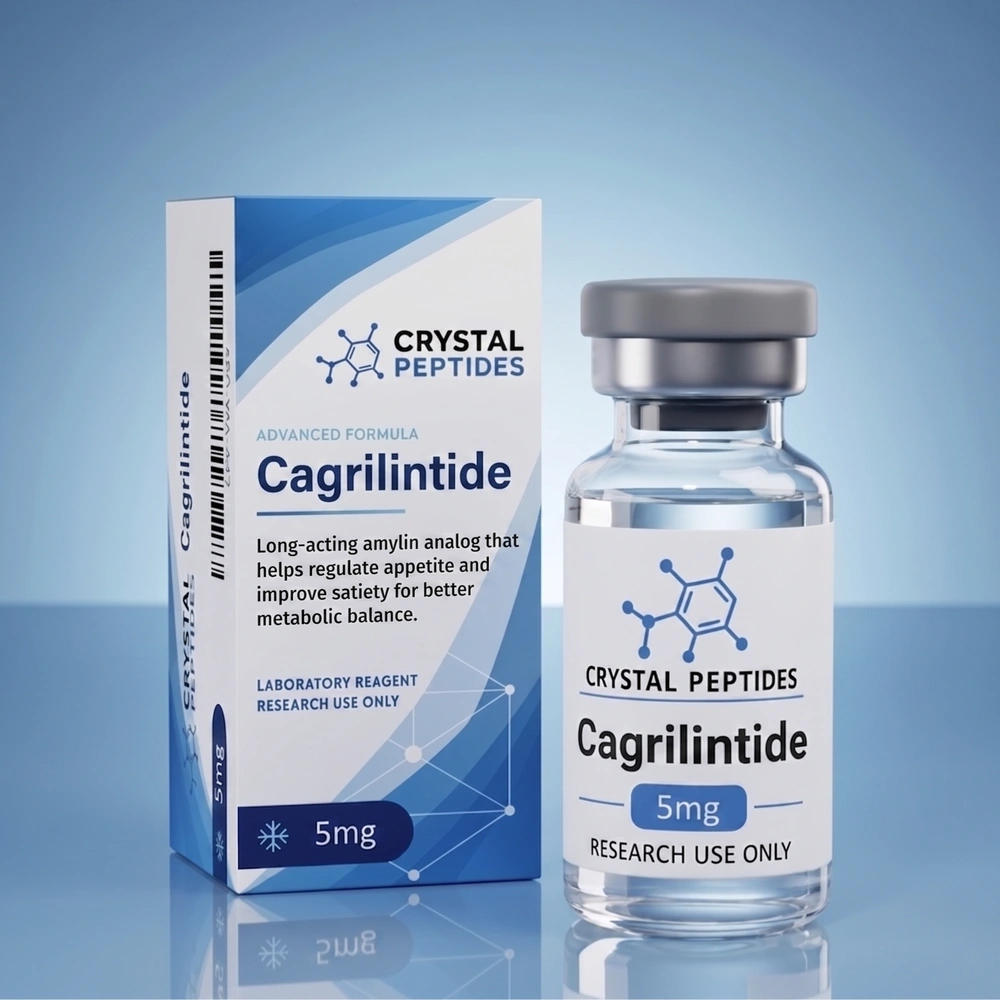
Cagrilintide
5mg
❄️Liofiliziran prašek (nerekonstituiran)
Skupaj: €59.99
Popust na količino
| Količina | Popust | Cena na enoto |
|---|---|---|
| 5 - 10 | 10% | €53.99 |
| 11 - 20 | 15% | €50.99 |
| 21+ | 20% | €47.99 |
Strogo testiranje tretjih oseb
Vsaka serija naših raziskovalnih kemikalij in peptidov je podvržena neodvisnemu laboratorijskemu testiranju tretje osebe glede čistosti in identitete.
Skupaj: €59.99
OPIS
Kagrilintid je sintetični dolgo delujoči analog amilina, trebušnega hormona, ki se skupaj z insulinom izloča iz beta celic trebušne slinavke kot odziv na obrok. Deluje kot neselektivni agonist na treh fenotipih amilinskih receptorjev AMY1R, AMY2R in AMY3R ter na receptorju za kalcitonin.
Amilinski receptorji niso ločeni geni; namesto tega je vsak sestavljen iz kalcitoninskega receptorja, G-protein sklopljenega receptorja razreda B, ki je povezan z enim od treh proteinov, ki modulirajo aktivnost receptorja (RAMP1, RAMP2 ali RAMP3). Ta skupna arhitektura pojasnjuje, zakaj lahko en peptid aktivira tako kompleks amilinskega receptorja kot tudi širšo družino kalcitoninskih receptorjev.
Raziskovalci lahko kupijo kagrilintid 5mg v Evropi pri Crystal Peptides. To je visoko čist raziskovalni peptid, neodvisno testiran s strani akreditiranih laboratorijev za identiteto, čistost in analitično konsistentnost peptida. Poleg tega je vsaki seriji priložen certifikat o analizi, ki ga je mogoče neposredno slediti neodvisnemu testirnemu laboratoriju za doslednost pri raziskavah amilinskih receptorjev in presnove.
Strukturne modifikacije kagrilintida
Molekula je zgrajena na hrbtenici človeškega amilina s šestimi ciljanimi zamenjavami aminokislin skupaj z lipidno konjugacijo, ki podaljša njen razpolovni čas v obtoku. Vsaka modifikacija prispeva k stabilnosti peptida, aktivnosti receptorja ali farmakokinetičnemu profilu:
- Pro25, Pro28 in Pro29 so zamenjani iz podganjega amilina, da bi zmanjšali nagnjenost k β-ploščam, preprečili tvorbo amiloidnih fibrilov in izboljšali stabilnost peptida med formulacijo.
- Glu14 in Arg17 sta vpeljana za stabilizacijo centralne α-spirale s tvorbo solnega mostu.
- Disulfidni most med Cys2 in Cys7 je ohranjen iz naravnega amilina, kar ohranja pomembno strukturno značilnost peptida.
- C-terminus je amidiran, kar izboljša odpornost proti encimski razgradnji.
- Pro37 nadomešča tirozin, ki ga najdemo tako v človeškem amilinu kot v pramlintidu, modifikacija pa je prevzeta iz kalcitonina za povečanje potency na kalcitoninskem receptorju. Kruse et al. to substitucijo eksplicitno opisujejo v originalnem razvojnem članku, registrirana molekulska formula pa se rekonstruira samo s prolinom na tem položaju. Več prodajnih in referenčnih strani napačno opisuje substitucijo kot P37Y, medtem ko je dejanska modifikacija Tyr37 → Pro37.
- C20 maščobna dikislina je pritrjena na stransko verigo lizina na položaju 1 prek γ-glutamatnega vezalca, kar spodbuja reverzibilno vezavo albumina in podaljšuje razpolovni čas eliminacije na približno 159–195 ur, v primerjavi z 20–45 minutami za pramlintid. Ta podaljšani razpolovni čas omogoča enkrat tedenske raziskave in je glavni razlog, zakaj kagrilintid obstaja kot ločen dolgo delujoči analog.
Kagrilintid v primerjavi z inkretinskimi spojinami
Kagrilintid se od spojin, s katerimi ga najpogosteje združujejo, razlikuje po tem, da ni inkretinski peptid. Semaglutid, tirzepatid in retatrutid izvajajo svoje biološke učinke preko sistemov receptorjev GLP-1, GIP in glukagon. Cagrilintid namesto tega deluje preko amilinske receptorske poti, kar vpliva na signalizacijo sitosti v predelih možganov, kot sta area postrema in hipotalamus. Ker so te poti komplementarne in se ne prekrivajo, se njihovi biološki učinki štejejo za aditivne in ne konkurenčne, kar zagotavlja znanstveno utemeljitev za preučevanje kagrilintida v kombinaciji s semaglutidom kot CagriSema.
Kemične lastnosti in registracijski podatki
Lastnost | Vrednost |
Ime in sinonimi | Cagrilintid, AM833, NN9838, NNC0174-0833, Cagri |
PubChem CID | 171397054 |
CAS številka | 1415456-99-3 |
Molekulska formula | C194H312N54O59S2 |
Molekulska masa | 4409.1 g/mol |
Dolžina peptida | 37 aminokislin |
Razred spojine | Dolgo delujoči acilirani amilinski analog |
Primarne tarče | AMY1R, AMY2R, AMY3R, kalcitoninski receptor (CTR) |
Potenca receptorja (človek) | cAMP EC50 0.348 nM pri AMY3R in 0.287 nM pri CTR; vezava IC50 0.170 nM pri AMY3R in 0.223 nM pri CTR (Kruse et al., 2021) |
Razpolovni čas | Približno 180 ur; poročano območje 159 do 195 ur |
Strukturne značilnosti | Disulfidni most Cys2-Cys7; amidiran C-terminus; C20 maščobna dikislina na Lys1 preko gama-glutamatnega vezalca |
Fizična oblika | Bel do umazano bel liofiliziran prašek |
Topnost | Bakteriostatična ali sterilna voda |
Razvijalec | Novo Nordisk |
Čistost | Glej COA |
Velikosti viale | Kagrilintid {potrdi: 10mg} |
Klinični podatki
Kagrilintid so preučevali tako samostojno kot tudi kot amilinsko komponento zdravila CagriSema, fiksne kombinacije s semaglutidom 2.4 mg. Razlika je pomembna, saj številke, ki se najpogosteje pripisujejo kagrilintidu, pripadajo kombinaciji.
- Faza 2 določanja odmerka (Lau et al., The Lancet, 2021): 706 odraslih, 26 tednov. Kagrilintid 4.5 mg je povzročil 10.8% povprečno zmanjšanje telesne teže v primerjavi s 3.0% na placebu in 9.0% na liraglutidu 3.0 mg, z jasnim odzivom na odmerek v razponu od 0.3 mg do 4.5 mg.
- Faza 1b kombinacije (Enebo et al., The Lancet, 2021): sočasno dajanje kagrilintida s semaglutidom 2.4 mg je doseglo 17.1% pri 20 tednih.
- Faza 2 pri sladkorni bolezni tipa 2 (Frias et al., The Lancet, 2023): 92 odraslih, 32 tednov. CagriSema 15.6% v primerjavi z 8.1% za sam kagrilintid in 5.1% za sam semaglutid.
- REDEFINE 1 (Faza 3, NEJM 2025): 3.417 odraslih z debelostjo in brez sladkorne bolezni tipa 2, randomiziranih 21:3:3:7 v skupino CagriSema (n=2.108), sam kagrilintid 2.4 mg (n=302), sam semaglutid 2.4 mg (n=302) ali placebo (n=705) za 68 tednov. Glede na oceno preskusnega izdelka, CagriSema 22.7%, kagrilintid 11.8%, semaglutid 16.1%, placebo 2.3%. Glede na oceno politike zdravljenja, 20.4%, 11.5%, 14.9% oziroma 3.0%.
- REDEFINE 2 (Faza 3, NEJM 2025): 1.206 odraslih s sladkorno boleznijo tipa 2. CagriSema 15.7% glede na oceno preskusnega izdelka, 13.7% glede na oceno politike zdravljenja, v primerjavi s 3.1% in 3.4% na placebu.
- REDEFINE 4 (Faza 3, poročano februarja 2026): primerjava s tirzepatidom 15mg v 84 tednih. CagriSema 23.0% v primerjavi z 25.5% za tirzepatid. Preskušanje ni doseglo svojega cilja neinferiornosti.
REDEFINE 1 je edino preskušanje faze 3, ki je kdaj izoliralo kagrilintid kot monoterapijo proti aktivnemu primerjalniku, in to je številka, ki jo je treba navesti za to spojino: 11.8% pri 68 tednih. V istem preskušanju, pod enakimi pogoji, je sam semaglutid dosegel 16.1%. Sam kagrilintid je bil šibkejši od obeh komponent. Razlika se poveča na zgornjem koncu: 40.4% skupine CagriSema je izgubilo 25% ali več telesne teže, v primerjavi s 16.2% na samem semaglutidu in 6.0% na samem kagrilintidu.
Podatki o stopnjevanju odmerkov kažejo enako smer. Pri 68 tednih je 82.5% skupine, ki je prejemala kagrilintid, prejemala najvišji odmerek, v primerjavi s 70.2% pri semaglutidu in 57.3% pri CagriSema. Udeleženci so kagrilintid dobro prenašali, da so pogosteje ostali pri najvišjem odmerku kot pri katerem koli primerjalniku, in kljub temu izgubili manj teže, kar postavlja zgornjo mejo monoterapije s kagrilintidom pri učinkovitosti in ne pri prenašanju. Vrednost spojine v objavljeni raziskovalni bazi je kombinatorna: semaglutidu doda približno šest do sedem odstotnih točk, prek receptorskega sistema, ki se ga semaglutid ne dotakne.
Gastrointestinalni učinki, predvsem slabost, so prevladujoče poročano opazovanje in so v veliki meri povezani s stopnjevanjem. V preskušanju faze 2 je 41% do 63% udeležencev, ki so prejemali kagrilintid, poročalo o gastrointestinalnih neželenih dogodkih v primerjavi z 32% na placebu, pri čemer je bila slabost prisotna pri 20% do 47% v primerjavi z 18%. Dolgoročni podatki o varnosti so še vedno predmet preučevanja.
Kagrilintid je v fazi preiskave in ga FDA, EMA ali kateri koli drug pomemben regulator ni odobril do leta 2026. CagriSema, fiksna kombinacija kagrilintida 2.4mg in semaglutida 2.4mg, je bila FDA predložena decembra 2025 in je še v pregledu; ni odobrena v ZDA ali EU. |
Raziskovalne aplikacije
Kagrilintid se uporablja kot molekularno orodje za preučevanje signalizacije amilina in poti sitosti, ki delujejo neodvisno od inkretinskega sistema. Ker aktivira kalcitoninski receptor skupaj z vsemi tremi fenotipi amilinskih receptorjev, omogoča raziskovalcem preučevanje, kako sestava RAMP oblikuje farmakologijo receptorjev znotraj ene družine receptorjev.
Farmakologija amilina in kalcitoninskega receptorja
Kagrilintid je skoraj ekvipotent pri AMY3R in kalcitoninskem receptorju, in ta neselektivnost je bistvo molekule, ne pa njena pomanjkljivost. Selektivno agoniziranje samo kalcitoninskega receptorja ne nadzoruje telesne teže v eksperimentalnih modelih, medtem ko to počnejo tako selektivni agonisti amilinskega receptorja kot tudi neselektivni agonisti. Kagrilintid se nahaja na enem koncu te osi in raziskovalcem nudi referenčno spojino za primerjalno delo proti selektivnim analogom, kot je eloralintid, in proti nativnemu amilinu, lososovemu kalcitoninu in pramlintidu.
Čas bivanja receptorja in signalna kinetika
Fletcher et al. so kagrilintid okarakterizirali po 25 farmakoloških končnih točkah in poročali o prehodni vezavi na receptorje v razponu minut, bližje človeškemu kalcitoninu kot lososovemu kalcitoninu ali analogu AM1784 z dolgim časom bivanja. Čas bivanja je aktivna raziskovalna spremenljivka v tej družini receptorjev, in kagrilintid je standardna orodna spojina za preučevanje, kako se vezavna kinetika pretvarja v nadaljnje signaliziranje.
Tvorba amiloidnih fibrilov in stabilnost peptida
Človeški amilin je eden najbolj agregacijsko nagnjenih peptidnih hormonov, in odlaganje otočnih amiloidov je značilnost patologije sladkorne bolezni tipa 2. Kagrilintid vsebuje prolinske substitucije, pridobljene iz podgan, ki preprečujejo tvorbo beta-plošč, zaradi česar je uporaben v primerjalnih študijah kinetike fibrilacije, nukleacije in zaporednih določil nagnjenosti k amiloidu.
Kombinirana signalizacija z inkretinskimi potmi
Amilinski in GLP-1 receptorski sistemi so anatomsko in mehansko ločeni. Celični in živalski modeli uporabljajo kagrilintid skupaj z agonisti GLP-1 receptorja za preučevanje, kako medsebojno delujeta dve neprekrivajoči se poti sitosti, ali je interakcija aditivna ali sinergistična, in kje se signali konvergirajo v zadnjih možganskih in hipotalamičnih vezjih.
Praznjenje želodca in postprandialna obdelava glukoze
Amilin upočasnjuje praznjenje želodca in zavira postprandialno sproščanje glukagona. Cagrilintide se uporablja za raziskovanje teh učinkov na tedenski namesto na obrok-časovni lestvici, kar ločuje tonično aktivacijo amilinskega receptorja od pulzov, povezanih z obrokom, ki jih proizvajajo kratkodelujoči analogi.
Kako deluje Cagrilintide (mehanizem delovanja)
Cagrilintid je neselektivni agonist družine kalcitoninskih receptorjev: samega kalcitoninskega receptorja in treh fenotipov amilinskih receptorjev, ki nastanejo, ko se dimerizira z RAMP1, RAMP2 ali RAMP3.
Ciljna angažiranost
Kalcitoninski receptor je izražen na celični površini tako samostojno kot v kompleksu z RAMPs. Samostojen močno reagira na kalcitoninske peptide in šibko na amilin. V paru z RAMPs se njegova farmakologija spremeni: visoka afiniteta za amilin, šibek odziv na človeški kalcitonin. Kagrilintid je potenten pri obeh fenotipih, kar je bil cilj konstruiranja C-terminalnega prolina, izvedenega iz kalcitonina. C20 maščobna dikislina na Lys1 se reverzibilno veže na albumin in drži peptid v obtoku.
Nadaljnje signalne poti
Tako kot drugi GPCR-ji razreda B1 se družina receptorjev kanonično povezuje z Gs, aktivira adenilat ciklazo in zvišuje znotrajcelični ciklični AMP, z mobilizacijo znotrajceličnega kalcija in fosforilacijo ERK kot nadaljnjimi izmerjenimi končnimi točkami. Sestava RAMP modulira profil, ne da bi ga preklopila, tako da isti agonist proizvaja različne odzivne signature, odvisno od prisotnosti RAMP. To je lastnost, zaradi katere je ta družina stalna tema raziskav o pristranosti signalizacije.
Celularni učinki v eksperimentalnih modelih
V predkliničnih modelih kagrilintid zmanjšuje vnos hrane na odvisen način od odmerka in povzroča trajno zmanjšanje telesne teže ob enkrat tedenskem dajanju. Mesto signalizacije je area postrema in hipotalamus in ne periferija, pot pa je neodvisna od aktivacije receptorja GLP-1, zato njuna kombinacija proizvaja aditivne učinke.
Kagrilintid v primerjavi s sorodnimi raziskovalnimi spojinami
Kagrilintid je edina spojina v tej skupini, ki ni inkretinski analog. Ostale tri so razvrščene po tem, koliko inkretinskih receptorjev aktivirajo; kagrilintid stoji zunaj te serije na ločenem hormonskem sistemu.
Lastnost | ||||
Tip | Sintetični amilinski peptidni analog | Sintetični GLP-1 peptidni analog | Sintetični dvojni agonistni peptid | Sintetični trojni agonistni peptid |
Hormonski sistem | Amilin in kalcitonin | Inkretin | Inkretin | Inkretin |
Primarne tarče | AMY1R, AMY2R, AMY3R, CTR | GLP-1R | GIPR, GLP-1R | GLP-1R, GIPR, GCGR |
Razred | Neselektivni agonist amilinskega in kalcitoninskega receptorja | Posamezni agonist | Dvojni agonist | Trojni agonist |
Razlikovalna pot | Amilinska signalizacija sitosti, neodvisna od inkretinskih receptorjev | Osnovna inkretinska pot | GIP receptor dodan GLP-1 | Glukagonski receptor: poraba energije, jetrna oksidacija maščob |
Najvišja prijavljena izguba teže v preskušanju, kot monoterapija | 11.8% pri 68 tednih (REDEFINE 1) | 16.1% pri 68 tednih (REDEFINE 1); približno 15% (STEP 1) | Približno 21% | Do 24.2% (Ph2), do 30.3% (Ph3, huda debelost) |
Razpolovni čas | Približno 7 dni | Približno 7 dni | Približno 5 dni | Približno 6 dni |
Razvijalec | Novo Nordisk | Novo Nordisk | Eli Lilly | Eli Lilly |
Klinična faza | Raziskovalno; razvito kot amilinska polovica CagriSema | Odobreno kot zdravilo | Odobreno kot zdravilo | Raziskovalno, faza 3 |
Dobavljeno tukaj kot | Spojina za raziskovalno uporabo | Spojina za raziskovalno uporabo | Spojina za raziskovalno uporabo | Spojina za raziskovalno uporabo |
Podatki za kagrilintid in semaglutid so povzeti iz istega preskušanja, REDEFINE 1, in so neposredno primerljivi. Podatki za tirzepatid in retatrutid so povzeti iz ločenih kliničnih preskušanj in niso primerjave ena na ena. Status odobritve se nanaša na licenčna zdravila. Vse spojine dobavlja Crystal Peptides izključno kot raziskovalne reagente.
Preglednico berite po poti in ne po odstotkih. Semaglutid, tirzepatid in retatrutid so ista ideja v naraščajočem obsegu: en inkretinski receptor, nato dva, nato trije. Kagrilintid je drugačna ideja. Sam po sebi povzroči manjšo izgubo teže kot kateri koli od njih, in to ni primerjava, ki jo dela raziskovalna baza. Primerjava, ki jo dela, je, kaj se zgodi, ko se analóg amilina doda inkretinu, kar je v REDEFINE 1 predstavljalo približno šest do sedem odstotnih točk več kot sam semaglutid.
Kakovost in testiranje
Vsaka serija je testirana z HPLC in neodvisno preverjena z analitskim testiranjem Janoshik, s potrdilom o analizi, specifičnim za serijo. Ponarejeni in generični skupni COA so na tem trgu razširjeni. Preverjanje tretjih oseb na ravni serije proti imenovanemu laboratoriju je edina zanesljiva kontrola.
Amilinski analógi nosijo specifičen način odpovedi, ki ga številka čistosti ne bo razkrila. Starševski hormon se agregira v amiloidne fibrile, in čeprav prolinske substitucije v kagrilintidu zavirajo to nagnjenost, lahko material, ki je bil pretresen, toplotno obremenjen ali večkrat zamrznjen in odmrznjen med prevozom, vsebuje agregate, ki jih kromatogram, narejen na svežem materialu, ni nikoli videl. Ravnanje je tukaj pomembno na način, kot ni za večino majhnih peptidov.
Regulativno in pravno
Vsi izdelki, ki jih dobavlja Crystal Peptides, so namenjeni izključno za raziskovalne in razvojne namene. Ti materiali so na voljo za laboratorijske raziskave in niso namenjeni za uporabo pri ljudeh ali živalih.
Ta izdelek ni zdravilo, hrana, prehransko dopolnilo, medicinski pripomoček ali kozmetični izdelek. Kagrilintid ni odobren kot zdravilo s strani Evropske agencije za zdravila, Ameriške agencije za hrano in zdravila ali katerega koli drugega nacionalnega regulatorja. CagriSema, fiksna kombinacija kagrilintida in semaglutida, je v pregledu pri FDA po predložitvi decembra 2025 in ni odobrena v ZDA ali EU. Semaglutid je ločeno odobren kot zdravilo pod licenciranimi blagovnimi znamkami; ta odobritev se nanaša na te licencirane izdelke in ne na raziskovalni material. Vse izjave v zvezi s spojino izhajajo iz objavljenih znanstvenih raziskav in jih ni ocenil noben regulativni organ. Ti materiali niso namenjeni za diagnosticiranje, zdravljenje, ozdravitev ali preprečevanje katere koli bolezni.
Z materiali smejo ravnati le kvalificirani strokovnjaki, usposobljeni za laboratorijske raziskovalne postopke. Vnos tega izdelka v ljudi ali živali je prepovedan in lahko krši veljavne zakone in predpise. Kupci so odgovorni za zagotovitev, da je vsa uporaba, shranjevanje, ravnanje in odstranjevanje v skladu z veljavnimi nacionalnimi in lokalnimi predpisi. Pravila o nakupu in uvozu raziskovalnih kemikalij se razlikujejo po državah.
LABORATORIJSKI REAGENT, SAMO ZA RAZISKOVALNE NAMENE. Ni zdravilo ali hrana. Ni za prehrano ljudi.
Viri in reference
- Kruse T, Hansen JL, Dahl K, et al. Development of Cagrilintide, a Long-Acting Amylin Analogue. Journal of Medicinal Chemistry. 2021;64(15):11183-11194. PMID: 34288673
- Lau DCW, Erichsen L, Francisco AM, et al. Once-weekly cagrilintide for weight management in people with overweight and obesity: a multicentre, randomised, double-blind, placebo-controlled and active-controlled, dose-finding phase 2 trial. The Lancet. 2021;398(10317):2160-2172. PMID: 34798060
- Fletcher MM, Keov P, Truong TT, et al. AM833 Is a Novel Agonist of Calcitonin Family G Protein-Coupled Receptors: Pharmacological Comparison with Six Selective and Nonselective Agonists. Journal of Pharmacology and Experimental Therapeutics. 2021;377(3):417-440.
- Enebo LB, Berthelsen KK, Kankam M, et al. Safety, tolerability, pharmacokinetics, and pharmacodynamics of concomitant administration of multiple doses of cagrilintide with semaglutide 2.4 mg for weight management: a randomised, controlled, phase 1b trial. The Lancet. 2021;397(10286):1736-1748.
- Frias JP, Deenadayalan S, Erichsen L, et al. Efficacy and safety of co-administered once-weekly cagrilintide 2.4 mg with once-weekly semaglutide 2.4 mg in type 2 diabetes: a multicentre, randomised, double-blind, active-controlled, phase 2 trial. The Lancet. 2023;402(10403):720-730.
- Garvey WT, Bluher M, Osorto Contreras CK, et al. Coadministered Cagrilintide and Semaglutide in Adults with Overweight or Obesity (REDEFINE 1). New England Journal of Medicine. 2025.
- Davies M, et al. Cagrilintide-Semaglutide in Adults with Type 2 Diabetes and Overweight or Obesity (REDEFINE 2). New England Journal of Medicine. 2025.
- Structural and dynamic features of cagrilintide binding to calcitonin and amylin receptors. Nature Communications. 2025. doi:10.1038/s41467-025-58680-y
- Novo Nordisk. Novo Nordisk files for FDA approval of CagriSema. 18 December 2025.
- PubChem Compound Summary for CID 171397054, Cagrilintide. National Center for Biotechnology Information.
Pogosto zastavljena vprašanja
Kaj je Cagrilintide?
Cagrilintide (AM833) je dolgo delujoči sintetični analog amilina, ki ga je razvil Novo Nordisk. Za razliko od inkretinskih peptidov, kot so semaglutid, tirzepatid in retatrutid, cagrilintide deluje predvsem preko amilinskega receptorskega sistema skupaj s kalcitoninskim receptorjem. Crystal Peptides ga dobavlja izključno za laboratorijske raziskave in razvoj in ni odobren medicinski izdelek.
Zakaj se Cagrilintide imenuje AM833?
AM833 je interna razvojna koda Novo Nordisk, ki se uporablja v večini objavljene znanstvene literature, vključno s farmakološkimi študijami Fletcher et al. Drugi razvojni identifikatorji, vključno z NN9838 in NNC0174-0833, se nanašajo na isto raziskovalno spojino, medtem ko je "Cagri" postal pogosta kratica v raziskovalni skupnosti.
Kakšna je razlika med Cagrilintide in CagriSema?
Cagrilintide je enojni peptid, medtem ko je CagriSema fiksna kombinacija odmerkov, ki vsebuje cagrilintide in semaglutid. Ker CagriSema združuje dve ločeni aktivni molekuli, nima lastne številke CAS, molekulske formule ali molekulske mase. Veliko kliničnih izidov, ki so na spletu navedeni za "cagrilintide", dejansko izvirajo iz študij, ki so preučevale kombinacijo CagriSema in ne samo cagrilintida.
Kje lahko kupim Cagrilintide na spletu?
Raziskovalci v Evropi lahko kupijo Cagrilintide na spletu pri Crystal Peptides kot visoko čist raziskovalni peptid, neodvisno testiran s strani akreditiranih laboratorijev. Vsaki seriji je priložen certifikat o analizi (COA), specifičen za serijo, ki raziskovalcem omogoča preverjanje identitete peptida, čistosti in analitične konsistence, preden material vključijo v laboratorijske raziskave.
Kako se Cagrilintide razlikuje od Semaglutida?
Glavna razlika je v hormonskih sistemih, na katere ciljata. Semaglutid je selektivni agonist receptorja GLP-1, medtem ko cagrilintide deluje predvsem prek amilinskega receptorskega sistema skupaj s kalcitoninskim receptorjem. Ker so te signalne poti komplementarne in se ne prekrivajo, raziskovalci pogosto primerjajo obe spojini za preučevanje različnih vidikov endokrine regulacije in presnovne fiziologije. Ta komplementarna biologija tvori tudi znanstveno utemeljitev za raziskovalno fiksno kombinacijo, znano kot CagriSema.
Kako se Cagrilintide razlikuje od Pramlintida?
Oba peptida sta dolgo delujoča analoga naravno prisotnega hormona amilina in si delita prolinske substitucije, ki zmanjšujejo tvorbo amiloidnih fibrilov. Vendar je bil cagrilintid zasnovan tako, da doseže bistveno daljši razpolovni čas v obtoku z reverzibilno vezavo albumina, kar omogoča enkrat tedenske raziskave v kliničnih študijah. Prav tako kaže aktivnost na kalcitoninskem receptorju, medtem ko je pramlintid predvsem agonist amilinskega receptorja. Pramlintid je odobren medicinski izdelek, medtem ko cagrilintid ostaja raziskovalna spojina.
Zakaj toliko strani pravi, da Cagrilintide povzroči več kot 20 % izgubo teže?
Velik del te zmede izhaja iz dejstva, da mnogi spletni viri navajajo rezultate zdravila CagriSema in ne samo zdravila cagrilintide. V študiji faze 3 REDEFINE 1 je bila široko poročana 22.7-odstotna povprečna izguba telesne teže opažena v skupini, ki je prejemala kombinacijo cagrilintida in semaglutida. Skupina, ki je prejemala samo cagrilintide, je v isti študiji poročala o 11.8-odstotni izgubi teže. Razlikovanje med samim peptidom in kombiniranim izdelkom je bistveno pri interpretaciji objavljenih kliničnih raziskav. Te številke so predstavljene izključno za povzetek znanstvene literature in jih ne bi smeli razlagati kot dokaz odobrene terapevtske uporabe.
Ali je CagriSema odobrena?
Od leta 2026 CagriSema ni odobrena kot zdravilo. Novo Nordisk je decembra 2025 pri Ameriški agenciji za hrano in zdravila (FDA) vložil vlogo za registracijo novega zdravila na podlagi kliničnega programa REDEFINE, javne potrditve vloge pri Evropski agenciji za zdravila pa ni bilo. Kakršnakoli prihodnja odobritev bi veljala le za licenčni izdelek CagriSema in ne za cagrilintid raziskovalne kakovosti.
Ali je Cagrilintide legalen in ali je potreben recept?
Cagrilintide ostaja raziskovalna spojina in ni odobren za terapevtsko uporabo pri ljudeh v nobeni pomembni jurisdikciji. Crystal Peptides dobavlja cagrilintide izključno kot laboratorijski raziskovalni peptid in ne kot zdravilo. Ker je dobavljen samo za raziskovalne namene, zahteve glede recepta ne veljajo na enak način kot za odobrena zdravila. Raziskovalci so odgovorni za zagotovitev, da so nakup, uvoz, posedovanje in uporaba raziskovalnih spojin v skladu z zakoni, ki veljajo v njihovi državi.
Ali je Cagrilintide prepovedan v športu?
Dejansko, da. Ker cagrilintide ni odobren medicinski izdelek, spada v kategorijo Svetovne protidopinške agencije (WADA), ki zajema neodobrene snovi (S0), ki so prepovedane tako med tekmovanjem kot izven njega. Ne smejo ga uporabljati športniki, ki so predmet protidopinških predpisov.
Kako naj se Cagrilintide rekonstituira in shranjuje?
Cagrilintide je dobavljen kot liofiliziran peptid in se običajno rekonstituira s sterilno vodo ali bakteriostatsko vodo, ki se počasi dodaja po notranji steni viale. Raztopini je treba omogočiti, da se naravno raztopi brez močnega mešanja ali vrtinčenja, saj pretirana mehanska obremenitev lahko spodbuja agregacijo pri peptidih iz družine amilina. Liofilizirane viale je treba shranjevati pri -20 °C ali manj, zaščitene pred svetlobo in vlago. Po rekonstituciji je treba raztopine običajno shranjevati v hladilniku pri 2–8 °C in zaščitene pred ponavljajočimi se cikli zamrzovanja in odmrzovanja.
Ali je Cagrilintide podjetja Crystal Peptides testiran s strani tretje osebe?
Da. Vsaka serija cagrilintida, ki jo dobavlja Crystal Peptides, je podvržena neodvisnemu analitskemu testiranju tretje osebe in je opremljena s potrdilom o analizi, specifičnim za serijo. Raziskovalci lahko pregledajo COA, da preverijo identiteto peptida, čistost in analitično kakovost za točno določeno dobavljeno serijo, kar zagotavlja preglednost in sledljivost, pričakovano za laboratorijske raziskave.
Ali pošiljate Cagrilintide po Evropi?
Da. Crystal Peptides pošilja cagrilintid po vsej Evropi v diskretni embalaži in s sledljivimi dostavnimi storitvami. Informacije o destinacijah pošiljanja, predvidenih časih dostave in razpoložljivih možnostih dostave najdete na strani z informacijami o pošiljanju.
Namenjeno je izključno poskusom in vitro ter se ne sme:
- uporabljati v kliničnih preskušanjih pri ljudeh
- dajati ljudem v okviru poskusa ali raziskave
- posredovati tretji osebi za uporabo v raziskavah na ljudeh.